


Proud Partner of
Michigan State Athletics
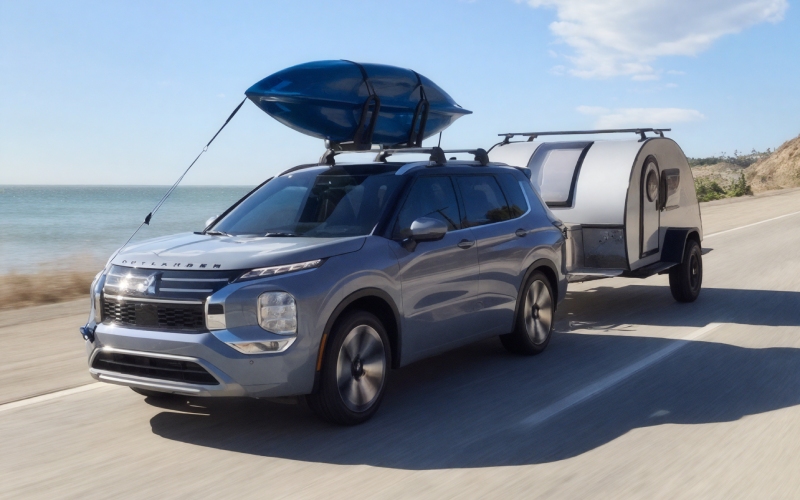
LaFontaine Mitsubishi Lansing – Which AWD system gives more everyday confidence around Holt, MI — 2026 Outlander S-AWC or 2026 RAV4 AWD?
Drivers across mid-Michigan ask a smart question when they cross-shop compact SUVs: which AWD system feels more reassuring in everyday conditions, the Outlander’s S-AWC or the RAV4’s AWD? Let’s unpack how each system works and, more importantly, how that translates to traction and calm behind the wheel around Holt, MI—on quiet neighborhood streets, during ramp merges, and when weather gets unpredictable.
What S-AWC Is Designed To Do
Super All-Wheel Control is Mitsubishi’s integrated traction strategy. Rather than simply shuffling power front to rear, it coordinates yaw control and brake-based torque vectoring with selectable drive modes to help you maintain your intended line. In plain language, S-AWC is working in the background to keep the SUV settled when grip changes—patchy slush at an intersection, wet leaves near a tree-lined curve, or that gritty film after a light dusting.
The Outlander layers in multiple modes—Tarmac, Gravel, Snow, Normal, Eco, and on select trims, Mud—so you can tune responses for surface and feel. Pair that with a 48-volt mild hybrid system that smooths throttle tip-in and you get a power delivery that’s easy to modulate, which makes a surprising difference when finesse matters.
How RAV4 AWD Approaches Confidence
RAV4’s available AWD systems also target traction and stability, and trims like Woodland add all-terrain tires to amplify grip in mixed conditions. The latest RAV4 lineup brings strong technology throughout the cabin, along with Toyota Safety Sense 4.0 driver aids and available features like Traffic Jam Assist and Advanced Park. If you’re coming from prior Toyotas, you’ll appreciate how familiar the controls and on-screen prompts feel.
From a driver’s seat perspective, the key difference is the Outlander’s more holistic coordination between power, braking, and steering cues through S-AWC. It can make transitions feel a touch more natural when the surface changes quickly—like the moment you leave a plowed subdivision and turn onto a road where wind has drifted powder back across the lanes.
On-Road Scenarios Around Holt, MI
Real life rarely hands you just one type of traction challenge. Consider these three common examples:
- Stop-sign starts on slick patches: S-AWC’s quick, subtle torque redistribution helps reduce initial wheelspin, so you roll forward cleanly.
- Curved on-ramps with damp leaves: Brake-based torque vectoring helps keep the nose tucked in as you add a little throttle to merge.
- Uneven snowmelt near driveways: The system reacts to mismatched grip left to right without feeling abrupt through the steering wheel.
RAV4’s AWD systems are certainly capable in all of these; the difference many shoppers notice in test drives is how composed the Outlander feels at the exact moments when balance is most helpful.
Tech That Supports Traction Confidence
Comfort and awareness features contribute to calm driving as much as raw traction. Outlander can be equipped with a Multi-View Camera System for a 360-degree look in tight lots and MI-PILOT Assist™ with Navi-link to reduce fatigue on longer stretches. Inside, Dynamic Sound Yamaha® Premium or the available Ultimate 12-speaker system adds concert-level clarity, with details like Speed Compensated Volume and Rain Compensated Volume that keep audio consistent. The RAV4 counters with a standard 12.3-inch digital gauge cluster, an available 12.9-inch multimedia touchscreen, Toyota Safety Sense 4.0, and available Traffic Jam Assist that helps in low-speed freeway congestion.
Both SUVs bring a high level of daily usability; Outlander distinguishes itself by tuning the traction, power delivery, and driver-assist features to feel very natural working together.
What About Space and Everyday Versatility?
Even if AWD confidence is the headline, most shoppers are also thinking about family and gear. Outlander’s standard third row is a practical advantage when a friend or two tags along after practice, and the 40:20:40 split second row makes long items simpler to carry. RAV4 seats five and gives you strong cargo flexibility as well. If you’re planning carpool rotations or want that just-in-case capacity, the Outlander’s layout can reduce the need for a larger, harder-to-park vehicle.
Frequently Asked Questions:
Is S-AWC always on, or do I need to activate it?
S-AWC is always monitoring conditions. You choose the drive mode that matches your surface or preference, and the system optimizes how traction and stability are managed in the background.
How does MI-PILOT Assist™ differ from features on the RAV4?
MI-PILOT Assist™ with Navi-link combines Adaptive Cruise Control with Stop & Go and Lane Keep Assist, and it can adjust speed based on navigation data. RAV4 offers Toyota Safety Sense 4.0, plus available Traffic Jam Assist and Advanced Park. Both ease driving; the feature sets and names differ by brand.
Do I need special tires to get the most from S-AWC?
Quality all-season or winter tires will allow any AWD system to perform at its best. S-AWC enhances stability and traction, and good tires provide the necessary grip to let the system shine.
If you want to compare these systems side by side and feel the differences in steering and throttle response, schedule a test drive with LaFontaine Mitsubishi Lansing—serving Holt, Grand Ledge, and Charlotte. We’ll map a quick route that simulates the mix of streets and speeds you drive most and walk you through the traction tech in clear, practical terms.
Request more 2026 Mitsubishi Outlander information

